
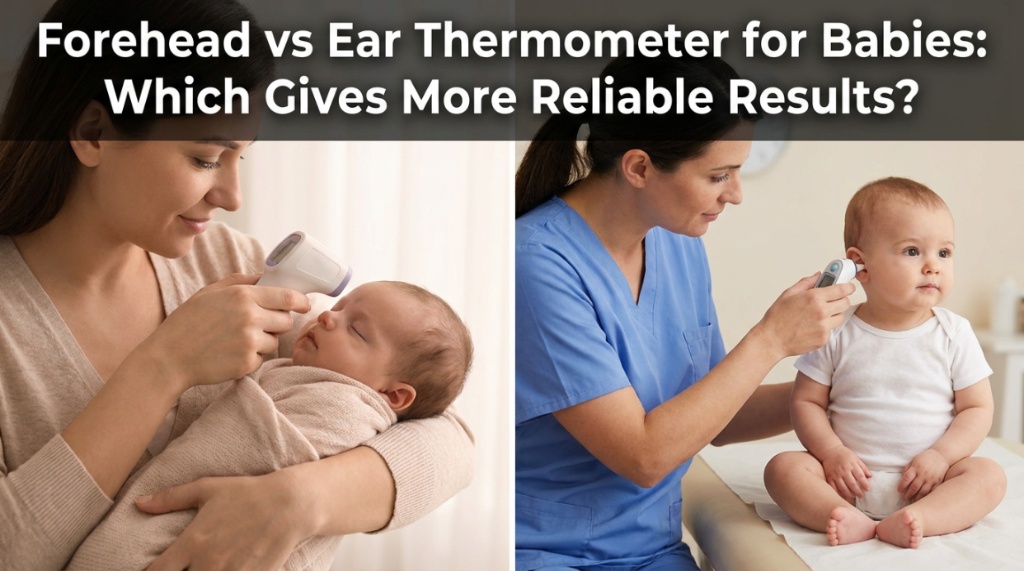
At 2 a.m., when a baby feels unusually warm and every minute feels longer than it actually is, parents are not looking for technology—they are looking for certainty. In the debate of Forehead vs Ear Thermometer for Babies, the most reliable answer is this: an ear thermometer typically provides readings that are closer to core body temperature when used correctly, while a forehead thermometer offers greater convenience, comfort, and consistency for quick screenings. The best choice depends on your baby’s age, movement, and the situation.
What Is the Difference Between a Forehead and Ear Thermometer?
Direct answer: A forehead thermometer measures temperature from the temporal artery on the forehead, while an ear thermometer measures infrared heat emitted from the eardrum and ear canal.
Both devices use infrared technology, but they gather temperature information from different parts of the body.
A temporal thermometer scans the forehead and captures heat from blood flowing through the temporal artery. It is non-invasive and can often provide a reading within seconds.
An infrared thermometer designed for ear use detects thermal radiation from inside the ear canal. Since the eardrum shares blood supply with the body’s temperature-regulating center in the brain, ear measurements often reflect core temperature more closely.
Key differences include:
- Measurement location
- Sensitivity to positioning
- Ease of use during sleep
- Accuracy under different conditions
- Suitability for different age groups
Parents researching temperature-monitoring devices often compare multiple options before deciding. Understanding the features discussed in this comprehensive baby thermometer buying guide can help narrow down the best choice for your family.
Which Thermometer Is More Accurate for Babies?
Direct answer: Ear thermometers generally provide more accurate measurements of core body temperature in babies older than six months when positioned correctly.
Accuracy is the primary reason many pediatric healthcare professionals continue to recommend ear thermometers for routine fever monitoring.
The eardrum receives blood flow from vessels connected to the hypothalamus, the body’s temperature-control center. This anatomical relationship allows ear readings to closely mirror internal body temperature.
However, accuracy depends heavily on proper technique. An incorrectly positioned probe can result in readings that are significantly lower than the actual temperature.
Forehead thermometers have improved substantially in recent years. Modern temporal artery scanners can achieve impressive accuracy when used according to manufacturer instructions. Nevertheless, they can be affected by:
- Sweat on the forehead
- Direct sunlight exposure
- Recent outdoor temperature changes
- Hair covering the scanning area
- Improper scanning motion
Several clinical evaluations have found that temporal artery thermometers are excellent screening tools, but ear thermometers often correlate more closely with core temperature measurements when properly used.
Can positioning affect ear thermometer accuracy?
Yes. Pulling the ear gently and aiming the probe toward the eardrum is critical. Even a small positioning error can produce inaccurate readings.
Can forehead thermometer placement affect results?
Yes. Scanning too quickly, measuring over sweat, or failing to follow the temporal artery path can reduce accuracy.
Are Forehead Thermometers Reliable Enough for Fever Detection?
Direct answer: Yes, forehead thermometers are generally reliable for identifying fever and monitoring temperature trends in babies.
For everyday parenting, reliability often matters as much as absolute accuracy.
A forehead thermometer offers several practical advantages:
- Fast readings
- Contact-free measurement options
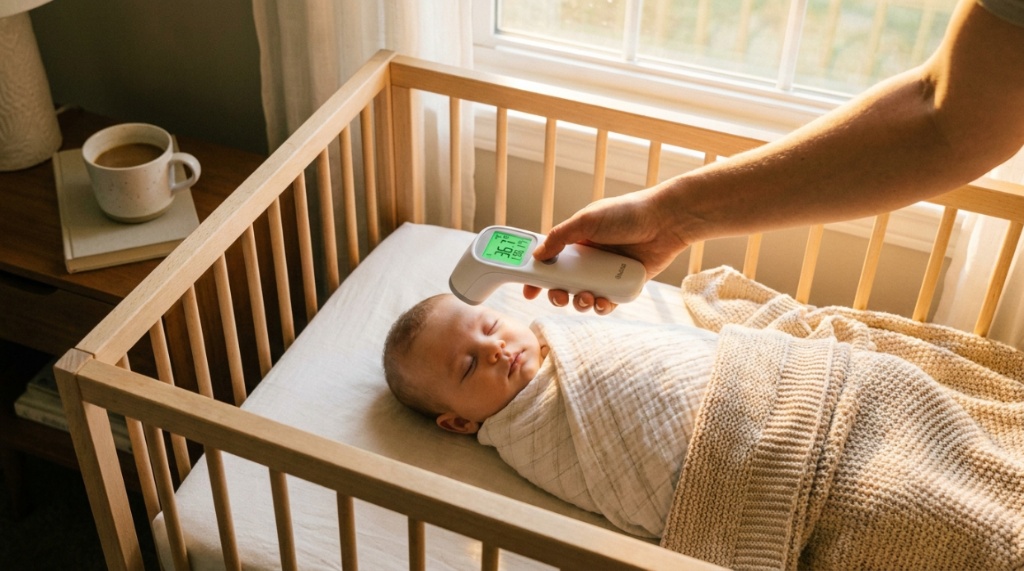
- Minimal disturbance during sleep
- Reduced risk of user error
- Comfortable use on restless infants
Many parents appreciate being able to check a sleeping child’s temperature without waking them. This convenience often leads to more frequent monitoring, which can provide a better understanding of fever progression.
When used consistently under similar conditions, a temporal thermometer is highly effective for tracking whether a baby’s temperature is rising, stable, or decreasing.
Healthcare providers often focus on fever trends rather than isolated readings. A consistently increasing temperature pattern may be more informative than a single measurement.
Which Thermometer Is Better for Newborns and Infants?

Direct answer: For newborns under three months, rectal thermometers remain the medical reference standard. For older infants, forehead thermometers are often easier to use, while ear thermometers become more effective after six months of age.
Age matters significantly when choosing a thermometer.
| Baby Age | Recommended Option | Reason |
|---|---|---|
| 0–3 Months | Rectal thermometer | Highest accuracy for medical evaluation |
| 3–6 Months | Forehead thermometer | Easier measurement and larger target area |
| 6+ Months | Ear or forehead thermometer | Ear canal is developed enough for reliable readings |
| Toddlers | Ear thermometer | Quick and highly accurate when positioned correctly |
One challenge with infants younger than six months is that their ear canals are small. This can make proper probe placement difficult and reduce ear thermometer accuracy.
For this reason, many pediatricians encourage parents to use forehead thermometers for routine checks during early infancy.
Why do doctors still recommend rectal thermometers for newborns?
Because rectal temperature remains the closest approximation of core body temperature. Any fever in a newborn should be discussed with a healthcare professional immediately.
How Does Ear Thermometer Accuracy Compare to Temporal Thermometers?
Direct answer: Ear thermometers often provide slightly more accurate estimates of core temperature, while temporal thermometers provide more consistent readings in active children.
The comparison is not simply about precision—it is also about practicality.
Ear thermometers excel when:
- The baby is older than six months
- The probe is correctly positioned
- The ear canal is free of excessive wax
- The child is cooperative
Temporal thermometers excel when:
- The baby is sleeping
- Rapid screening is needed
- Multiple children require checking
- Contact-free measurement is preferred
- The child resists ear measurements
Many hospitals and clinics use temporal artery devices because they balance speed, patient comfort, and clinical usefulness.
Parents should remember that even highly accurate thermometers have an acceptable measurement variation. Small differences between readings are normal and do not necessarily indicate device failure.
Can earwax affect readings?
Yes. Significant earwax buildup can interfere with infrared heat detection and may reduce measurement accuracy.
Can sweat affect forehead readings?
Yes. Moisture on the forehead may temporarily alter surface temperature readings.
What Are the Advantages and Disadvantages of Each Thermometer?
Direct answer: Ear thermometers prioritize accuracy, while forehead thermometers prioritize convenience and comfort.
Pros of Ear Thermometers
- Closer approximation of core temperature
- Very fast results
- Reliable for older infants and toddlers
- Useful for fever confirmation
- Widely used in clinical settings
Cons of Ear Thermometers
- Requires correct positioning
- Less suitable for very young infants
- Can be affected by earwax
- Difficult with moving children
- Probe covers may require replacement
Pros of Forehead Thermometers
- Non-invasive
- Easy for sleeping babies
- Quick measurements
- Simple learning curve
- Suitable for repeated monitoring
Cons of Forehead Thermometers
- Can be affected by environmental conditions
- May underestimate temperature after outdoor exposure
- Sensitive to sweat and skin moisture
- Slightly less reflective of core temperature
When Should Parents Use a Forehead Thermometer Instead of an Ear Thermometer?
Direct answer: Choose a forehead thermometer when the baby is sleeping, resisting ear measurements, or younger than six months.
There are many situations where convenience outweighs the slight accuracy advantage of ear devices.
Examples include:
- Checking a sleeping infant at night
- Monitoring fever progression every few hours
- Screening multiple family members quickly
- Taking measurements while traveling
- Assessing temperature without physical contact
A temporal thermometer can often provide a dependable answer in just seconds while minimizing stress for both parents and children.
How Can Parents Improve Thermometer Accuracy at Home?
Direct answer: Follow manufacturer instructions carefully, take multiple readings when necessary, and use the same thermometer consistently.
Regardless of thermometer type, proper technique significantly influences results.
Best practices include:
- Read the user manual completely
- Keep sensor lenses clean
- Avoid measurements immediately after bathing
- Wait after outdoor exposure
- Measure in a stable indoor environment
- Take repeat readings if results seem unusual
Parents should also avoid comparing temperatures from different body sites directly. An ear reading and a forehead reading may differ slightly even when both are accurate.
The most useful strategy is consistency. Using the same device over time provides a clearer picture of changes in temperature patterns.
Should You Buy an Ear Thermometer or a Forehead Thermometer?
Direct answer: Families with babies older than six months who prioritize precision may prefer an ear thermometer, while families seeking convenience and frequent monitoring often benefit more from a forehead thermometer.
The decision depends on your priorities.
If your primary goal is the closest possible estimate of core body temperature, an ear thermometer is often the stronger choice.
If your goal is stress-free, rapid temperature checks throughout the day and night, a forehead infrared thermometer may be the better investment.
Many parents eventually keep both devices: a forehead thermometer for routine monitoring and an ear thermometer for confirmation when fever is suspected.
Conclusion: Which Thermometer Delivers More Reliable Results for Babies?
Direct answer: Ear thermometers generally deliver the most reliable estimate of core temperature in babies older than six months, while forehead thermometers offer excellent reliability for screening, monitoring, and everyday use.
The debate between a temporal thermometer and an ear thermometer is not about choosing a winner for every situation. It is about matching the tool to the child’s age and the parent’s needs.
For precision, ear devices often have the advantage. For convenience, comfort, and quick fever checks, forehead thermometers remain exceptionally practical.
If you’re comparing models and features before making a purchase, this expert guide to choosing the right baby thermometer provides additional insights into selecting a reliable option.
The best thermometer is ultimately the one you can use correctly, consistently, and confidently when your baby needs it most.
Frequently Asked Questions
Is an ear thermometer more accurate than a forehead thermometer?
Yes. In babies older than six months, ear thermometers generally provide readings closer to core body temperature when positioned correctly.
Can I use an ear thermometer on a newborn?
It is not usually recommended. Newborn ear canals are very small, making accurate placement difficult. Rectal measurements remain the preferred standard for newborns.
Why does my forehead thermometer give different readings?
Environmental conditions can affect measurements. Sweat, room temperature, sunlight exposure, and scanning technique may influence results.
How often should I check my baby’s temperature during a fever?
Most parents check every few hours. Follow guidance from your healthcare provider and monitor symptoms in addition to temperature readings.
Can earwax make an ear thermometer inaccurate?
Yes. Excessive earwax can interfere with infrared heat detection and may reduce reading accuracy.
Should I trust a forehead thermometer reading?
Yes. Modern temporal thermometers are reliable for fever detection and temperature monitoring when used according to instructions.
What temperature is considered a fever in babies?
Generally, 100.4°F (38°C) or higher is considered a fever. Seek medical advice immediately for any fever in newborns under three months old.