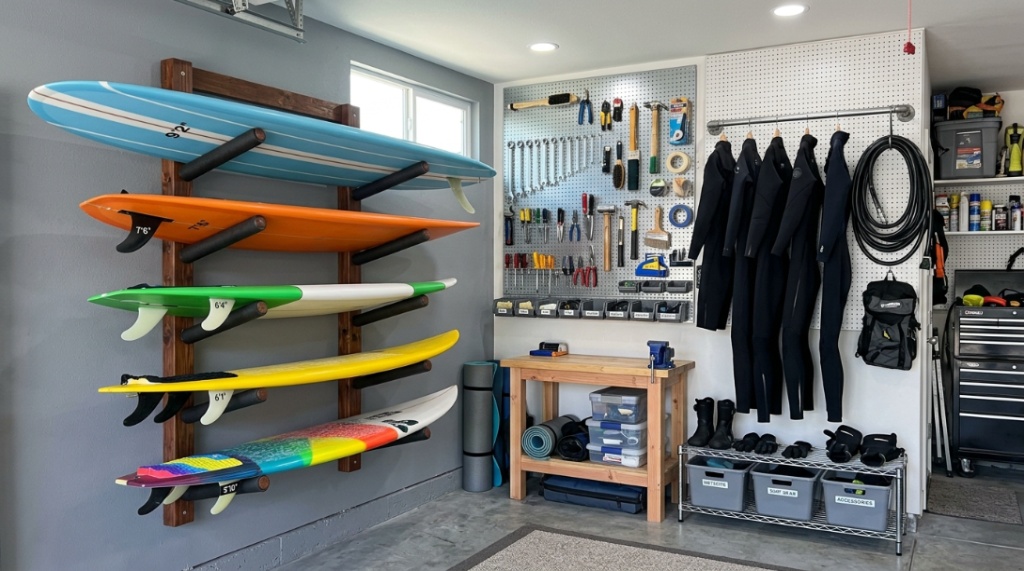
Most surfers live in apartments, condos, or homes where space is a premium — and a 6-to-9-foot surfboard doesn’t exactly fit neatly into a closet. The challenge of storing a board collection without sacrificing your living space drives the need for a surfboard organizer designed specifically for small space storage. The wrong rack wastes more space than it saves — jutting boards into walkways, occupying entire walls, or creating floor obstacles. The right rack maximizes vertical space, hugs walls tightly, and stores multiple boards in the footprint a single leaned board would occupy. Space-saving isn’t just about the rack’s size — it’s about how cleverly it uses dead space (high walls, ceilings, corners, doors) that’s otherwise wasted.
The surfboard storage market has exploded with space-efficient options specifically because surfers increasingly live in urban apartments and compact homes rather than beachfront houses with dedicated board rooms. Wall-mounted vertical racks, ceiling hoists, over-door hangers, and corner-mounted solutions now exist for every tight space scenario. The key is matching the right rack type to your specific space constraint — whether that’s limited wall length, low ceilings, shared spaces, or rental restrictions on mounting. Here’s how to choose a surfboard organizer that solves your storage problem without creating a space problem.
What Makes a Surfboard Rack “Space-Saving”?
A space-saving surfboard rack uses vertical height (walls, ceilings), dead corners, or minimal floor footprint rather than spreading boards across large horizontal areas — storing boards where they don’t compete with living space.
Space-saving design principles:
- Vertical stacking: Boards stored vertically on a wall use minimal floor space and horizontal wall length while holding multiple boards.
- Ceiling utilization: Hoists and ceiling racks use completely dead space — no floor or wall impact at all.
- Corner mounting: Corner racks exploit unused corner space that’s otherwise wasted in most rooms.
- Wall-hugging profile: Racks that keep boards tight to the wall (6–10 inches protrusion) rather than jutting 18+ inches into the room.
- Multi-board capacity: One rack holding 3–4 boards in the space a single leaned board would occupy.
Which Rack Type Saves the Most Space?
Ceiling-mounted hoists save the most space because they use completely dead overhead space — zero wall or floor impact. Wall-mounted vertical racks are the best practical choice for most homes, offering excellent space efficiency with easy daily access.
Space efficiency ranking:
| Rack Type | Floor Space Used | Wall Space Used | Overhead Space Used | Access Ease |
|---|---|---|---|---|
| Ceiling hoist | Zero | Zero | Board length × width | Moderate |
| Wall-mounted vertical | Zero | 2–3 ft width | None | Good |
| Wall-mounted horizontal | Zero | Board length | None | Good |
| Corner rack | Minimal (corner) | Corner only | None | Good |
| Freestanding | 2–4 sq ft | None | None | Excellent |
For most people: wall-mounted vertical racks offer the best balance of space efficiency and daily practicality. They hold 2–4 boards in just 2–3 feet of wall width and zero floor space, with easy access any time. Ceiling hoists are best when wall space is also limited, but the lift-down access is slightly less convenient for daily use.
How Do Vertical Wall Racks Save Space?
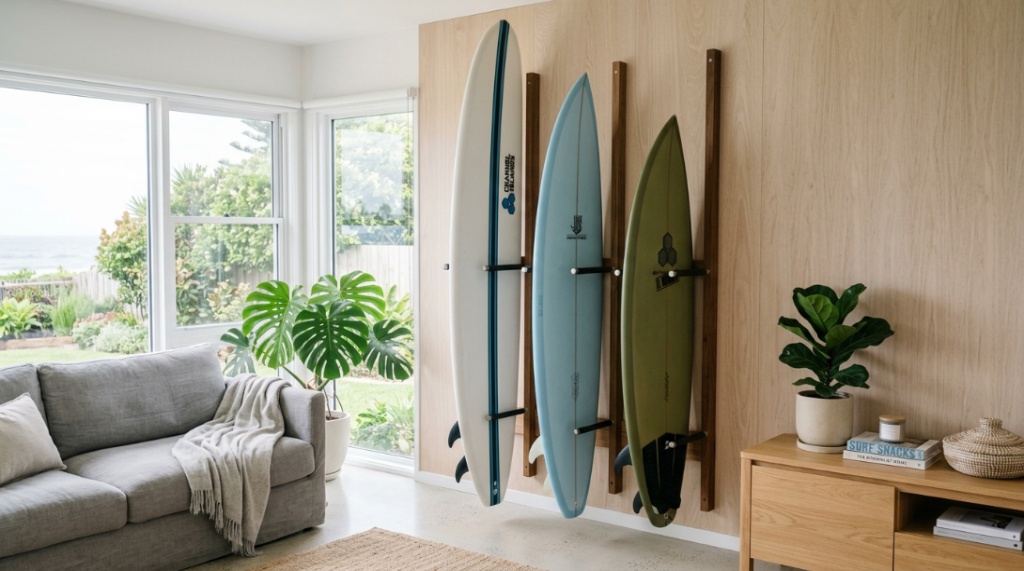
Vertical wall racks save space by stacking boards upright (nose-up or tail-up) against a wall, using the room’s full height rather than its limited floor or horizontal wall space — holding multiple boards in under 3 feet of wall width.
Vertical rack advantages:
- Minimal wall width: 2–3 feet of wall width holds 2–4 boards stacked side-by-side vertically.
- Zero floor space: Boards hang on the wall, freeing the floor completely.
- Height utilization: Uses the 6–9 feet of height most rooms have but don’t use for other storage.
- Visual appeal: Boards displayed vertically can look attractive as wall art — functional decoration.
- Easy access: Grab the board you want without moving others (if properly spaced).
racks work best for shortboards and mid-length boards (under 7’6″). Longboards (9’+) stored vertically require very high ceilings. For longboards in standard-height rooms, horizontal wall mounting or ceiling hoists may be more practical.
How Do You Choose a Rack for an Apartment or Rental?
For apartments and rentals, choose freestanding racks (no wall damage), tension-mounted systems (removable), or small-hole-only mounting solutions — avoiding large anchor holes that forfeit security deposits.
Rental-friendly options:
- Freestanding vertical racks: No mounting required. Lean against the wall with rubber feet. Hold 2–6 boards. Move with you when you move apartments.
- Tension-pole racks: Floor-to-ceiling tension poles with board hooks. No holes in walls. Adjustable height. Remove completely without trace.
- Door-mounted racks: Hook over a door frame to hold a board. Zero installation. Very space-efficient for single boards.
- Small-hole mounting: Standard picture-hook holes that are easily patched when you leave. Some wall-mount racks use only small screws that patch invisibly.
- Adhesive-mounted hooks: Heavy-duty adhesive hooks for lightweight boards (shortboards). Remove without wall damage. Weight-limited.
For renters, freestanding racks are the safest choice — zero wall damage, completely portable, and no landlord issues. If you need wall mounting, use the smallest possible fasteners and plan to patch holes upon move-out.
What Size Rack Do You Need for Your Board Collection?
Match rack capacity to your actual board count plus one spot for growth. Most recreational surfers need 2–4 board capacity, while serious surfers with quivers need 4–8 board storage — choose based on what you actually own.
Sizing guide:
- 1 board: Simple wall hooks, over-door hanger, or single ceiling hoist. Minimal investment needed.
- 2–3 boards: Wall-mounted dual/triple rack or small freestanding rack. The most common recreational surfer situation.
- 4–6 boards: Multi-tier wall system or larger freestanding rack. For active surfers with a quiver.
- 6+ boards: Custom wall systems, ceiling racks, or dedicated storage area. For serious collectors and multi-board riders.
Don’t overbuy capacity you won’t use — a 6-board rack in a small apartment takes more space than needed for 2 boards. But also plan for at least one extra spot — surfers tend to accumulate boards over time.
How Do You Choose Between Indoor and Outdoor Surfboard Racks?
Choose indoor racks for board protection (temperature, UV, theft) and outdoor racks for maximum space efficiency (garage exterior, covered patio, carport) — knowing that outdoor storage requires additional weather and security considerations.
Indoor vs. outdoor considerations:
- Indoor storage (recommended): Best board protection from heat, UV, theft, and weather. Climate-controlled. More limited space options.
- Outdoor covered storage (acceptable): Covered patios, carports, or covered garage exteriors. Protected from rain/sun but exposed to humidity and temperature swings. Use board bags.
- Outdoor exposed storage (avoid): Direct sun and rain exposure. UV damage, heat delamination, and weather degradation. Only acceptable for short-term (hours, not days).
In Florida: outdoor exposed storage is particularly risky due to intense UV, extreme heat, and frequent rain. If storing outside is the only option, use a covered area and keep boards in reflective board bags at all times. Indoor storage is always preferred for long-term board health.
What Are the Best Budget-Friendly Space-Saving Racks?
Budget-friendly space-saving options include DIY wall racks ($20–$40), basic freestanding racks ($40–$80), and simple ceiling hoists ($30–$60) — all achieving effective space savings without premium pricing.
Budget options by type:
- DIY padded wall arms ($20–$40): Wooden dowels or PVC in brackets, padded with foam. Custom to your space. Most affordable.
- Basic freestanding rack ($40–$80): Simple vertical or angled rack holding 2–4 boards. No installation. Portable.
- Simple ceiling hoist ($30–$60): Rope/pulley system for lifting one board to the ceiling. Basic but effective for space savings.
- Over-door hooks ($15–$30): Padded hooks that hang over a door frame. Single board only but zero installation and very space-efficient.
For most budget-conscious surfers, a DIY wall rack or basic freestanding rack solves the storage problem for under $60 while saving significant space compared to leaning boards unsecured.
Conclusion
Choosing a surfboard rack that saves space means matching the right storage type to your specific constraint — limited floor space (use wall-mounted), limited wall space (use ceiling hoists), rental restrictions (use freestanding), or multiple boards in tight spaces (use vertical stacking). The best space-saving racks use dead space that’s otherwise wasted: high walls, ceilings, corners, and door frames.
For most surfers in apartments or compact homes, a wall-mounted vertical rack offers the best combination of space efficiency, easy access, and affordable pricing ($30–$100). Freestanding racks suit renters who can’t mount to walls. Ceiling hoists maximize space in garages with high ceilings. Whatever you choose, ensure padded contact points protect your boards and secure mounting prevents falls. The right rack transforms a board collection from a space problem into organized, accessible, even attractive storage — without sacrificing the living space you need.
How many boards and what kind of space are you working with? Share in the comments — I’ll suggest the specific rack type and placement that maximizes your available space.
Choosing the right storage setup is all about optimizing your environment so you can focus entirely on performance when you hit the water. Just like organizing your garage removes mental friction before a session, upgrading your sports equipment can completely change your game on land. For instance, testing shows that Urethane Golf Balls Help Mid Handicappers Shoot Lower Scores by providing better spin control around the greens. Whether you are streamlining your surfboard storage or fine-tuning your golf gear, making deliberate choices about your equipment always yields better results.
Frequently Asked Questions
What surfboard rack saves the most space?
Ceiling-mounted hoists save the most total space (zero wall/floor impact) but are less convenient for daily access. Wall-mounted vertical racks are the best practical choice — holding 2–4 boards in under 3 feet of wall width with zero floor space used and easy daily access.
How do I store a surfboard in a small apartment?
Use a wall-mounted vertical rack (2–3 feet of wall width), freestanding rack (portable, no wall damage), or ceiling hoist (uses dead overhead space). For renters, freestanding or tension-pole racks avoid wall damage. Over-door hooks work for a single board with zero installation.
Can I store a surfboard vertically?
Yes — vertical storage (nose-up or tail-up) is perfectly safe and very space-efficient. Ensure the board rests on a padded surface at the bottom and has padded support preventing it from falling sideways. Vertical wall racks are designed specifically for this and are one of the most space-efficient options.
What’s the cheapest space-saving surfboard rack?
A DIY wall rack using wooden dowels, brackets, and pipe insulation foam costs $20–$40 in materials. Over-door hooks cost $15–$30 for a single board. Basic freestanding racks start around $40. All achieve effective space savings without premium pricing.
How do I store a surfboard without damaging walls?
Use freestanding racks (zero wall contact), tension-pole systems (no holes), over-door hooks, or adhesive-mounted solutions. For renters concerned about security deposits, these options provide proper storage without any wall damage or mounting holes.
Is it OK to store surfboards on the ceiling?
Yes, ceiling storage is excellent for space savings. Use a proper hoist or ceiling rack rated for your board’s weight. Caution in hot garages: heat rises, so ceiling storage in uninsulated spaces exposes boards to the highest temperatures. In climate-controlled indoor spaces, ceiling storage is ideal.